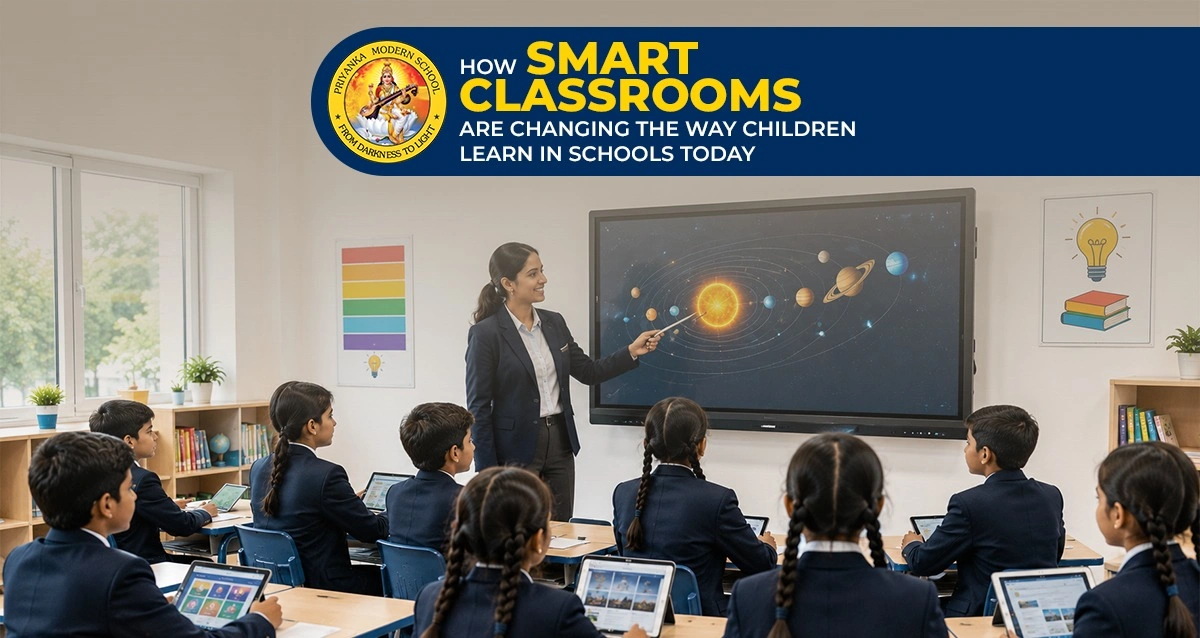
How Smart Classrooms Are Changing the Way Children Learn in
Schools Today
Chalkboards and notebooks were how school used to be; nowadays, schools increasingly use
technology to enhance student learning. Perhaps the most impressive recent innovation in schools
has been the implementation of smart classrooms at many educational institutions. These smart
classrooms in schools combine traditional teaching methods with technology-driven tools in order
to make student learning more interesting and effective.
Children are exposed to technology every day, so schools can adopt different approaches to
better prepare students for future studies. Smart classrooms enable children to acquire
knowledge faster, maintain student interest in lessons, and acquire lifelong skills.
What Is a Smart Classroom?
A smart classroom simply refers to a normal classroom that has been enhanced by technologies to
create a more interesting and playful environment for students to learn. Imagine large display
screens, projectors, smart boards, tablets, audiovisual aids, and more. It moves learning from a
one-way communication system where only the teacher talks to students, to actually seeing,
hearing, and even physically interacting with the lesson.
Take a history lesson on the Mughal Empire. On a single screen, we can have animated maps,
historical timelines, and videos of monuments all interacting with the learning content. Schools
that spend on smart classrooms are doing their students an immense service. Learning becomes an
enjoyable experience and not just a lecture.
Learning Becomes Visual and Fun
The kids today are exposed to the world of smartphones, television, and computers. You may
imagine how that will be; the children go into the classroom with no other way of understanding
topics than having a blackboard. Smart Classrooms fill up that gap. Learning is not just words;
it turns out to be visual. A subject of science about the pumping of the heart, instead of
having the children look through rows of texts, the children can view a 3-D animated heart in
3-D and actually look at the heart pumping blood with every pump. Previously, this could not be
comprehended, and now it seems very simple.
Students retain 80-90% of what they do and what they see, while students retain only 10-20% of
what they read. According to a study, Smart Classrooms are equipped with interactive tools that
are able to incorporate audiovisuals, animations, and quizzes to further help students learn.
They will be learning instead of forcing information down their throats.
Teachers Get Better Tools Too
Smart classrooms in schools are not just an advantage for students, but for teachers as well.
Instead of spending hours drawing figures or writing notes on the blackboard, teachers can
access a pre-prepared digital presentation that contains far more accurate figures and more
interesting graphics. They may pause the video presentation to explain a difficult concept, zoom
in on a figure, or simply bring out a short online quiz to see whether the students have grasped
what was being taught.
With a more effective use of time (teachers have more time to spend teaching and less on
preparing boring, routine tasks), students will inevitably perform better. Computer learning in
schools isn't a replacement for the teacher; it is the provision of better tools to the teacher.
Every Child Learns at Their Own Pace
This one-size-fits-all nature of traditional classrooms becomes one of the biggest struggles in
a classroom, given the fact that every child is different from the other – some learn very fast,
whereas some need time to grasp. A classroom that is powered by intelligence, however, provides
students with individual learning experiences.
In the case of digital lessons, students can rewind or pause them whenever they want. A student
who fails to grasp a concept during the first watch can replay it – this might happen during the
session or by the student at their own will and device. Conversely, students who can quickly
grasp the lessons can proceed with additional information, activities, and challenging tasks.
Here, nobody is held up, and nobody gets bored.
Making Schools in Smaller Cities Future-Ready
Good technology in education had previously been concentrated mainly in metropolitan cities such
as Delhi, Mumbai, and Bengaluru. However, this is quickly changing, and the standard of digital
learning offered in CBSE schools situated in a non-metropolitan city like Dhampur, with digital
classrooms, can rival any of the digital learning provided in major metros. This is huge for
smaller towns and their children. These students can now receive the benefits of
state-of-the-art learning without leaving their hometowns.
Students of Dhampur and the adjoining regions can now rest assured that they are not left behind
in any way. Good digital learning in schools is being deployed all over the country, and one can
see the results in the increased curiosity, confidence, and level of engagement of the students.
Building Skills for the Future
Let's face it, children are going to grow up in a world dominated by technology, a digital
world. From conducting business online to working remotely to participating in virtual meetings
and utilizing artificial intelligence systems, the digital experience will permeate their
future. Smart classrooms allow students to gain an early proficiency in technology. The skill
set gained by students in a smart classroom (like finding data, developing critical thinking
abilities, and problem-solving using technology) cannot be taught by a book alone.
What Parents Should Look For
If you are a parent searching for schools for your kid, here is a little advice. Prefer those
schools that consider Smart Classes as a regular teaching tool, and not just a once-a-week
affair. Are the teachers well-versed in using the smart tools? Does the school provide digital
content on topics of science, maths, and social science? Above all, does your kid come home
enthusiastic about what he learned, because the eagerness to learn is the key to every success.
A Small Story to Imagine
Imagine this. A sixth grader named Aarav comes back from school. His mom asks, "What did you
learn today?" Instead of shrugging and answering "nothing", Aarav runs to his bag, pulls out his
tablet, and says, "Mama, look – today we learned how plants make food for themselves! Just see!"
He shows her an animation that his teacher played in class. His mom watches and smiles, and even
she feels like she has learned something. That's the brilliance of smart classrooms; learning is
not confined to school, it follows children back to their homes and instills conversations and
curiosity.
Final Thoughts: The Road Ahead
The world around us is constantly evolving, and it is essential that education also evolves with
it. The smart classes, which are becoming a norm in schools, are no longer an extra add-on, but
rather a necessity and a prerequisite for the students who are growing up in a technologically
advanced world. These smart classes are a source of joy for students and have a significant role
in helping teachers teach better, and for the students to grasp things even more
efficiently.
Parents residing in Dhampur and the surrounding regions can consider this good news. There is no
need to send your child away from home, to a city far off, to get a smart education. A CBSE
school with smart classes in Dhampur, just like Priyanka Modern School, has everything
in store
for your child to thrive in the present competitive environment.
Thus, next time when you consider the future of your child, do pose this question: Is my child
actually learning, or merely studying? With smart classes, you have the answer without a single
second of thought-Your child is LEARNING and LOVING it.
Read more: Top CBSE
School with Smart Classes in Dhampur: A Complete Guide for Parents