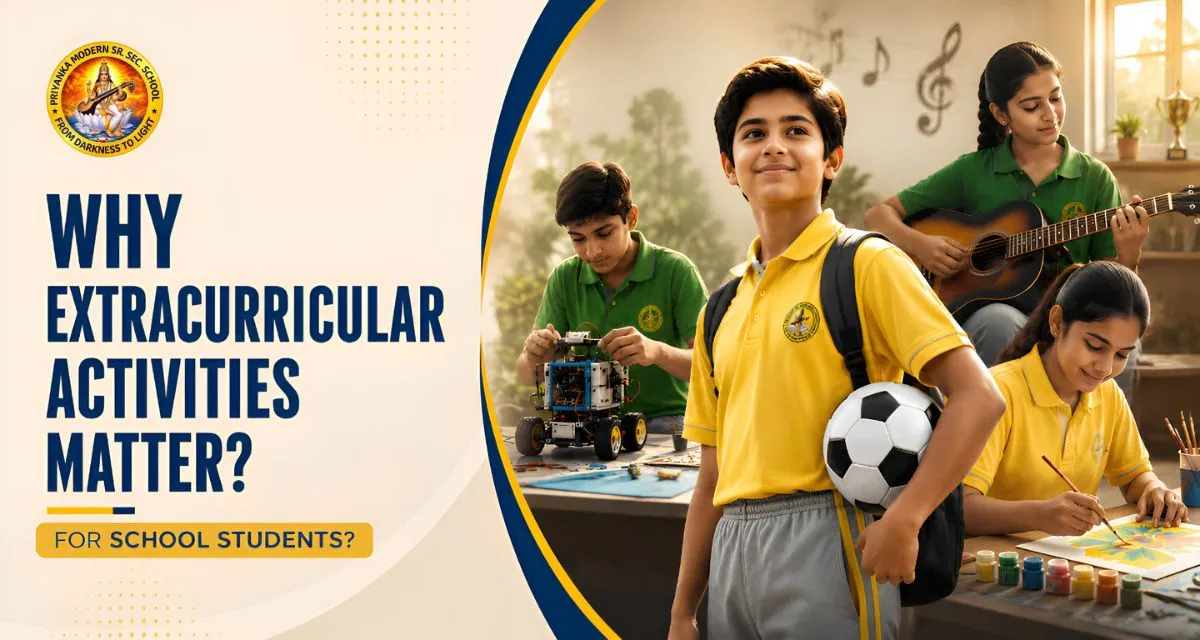
Why Extracurricular Activities Matter for School Students?
Ask most parents what they want from a good school and academics will come up first. Good results, strong teachers and a solid curriculum are the things that tend to drive the school selection conversation. And they matter, without question.
But here's something that parents who've watched their children grow through school years often say: the moments that shaped their child the most weren't always in the classroom. They were on the sports field, in the music room, at the annual day rehearsal,
during the science exhibition or at the investiture ceremony when their child stood in front of the whole school and took on a responsibility for the first time.
Extracurricular activities for students are not extras. They're not fillers between serious learning. They are, in many ways, where some of the most important learning of school life actually happens.
Extracurricular Activities Teach What Academics Alone Cannot Teach
A textbook can teach a student what teamwork means. It cannot teach them how to actually be a team player, how to handle disagreement, support a teammate who is struggling, push through a loss together and celebrate a win as a group rather than as an individual.
That kind of learning only happens through experience. And it happens consistently through extracurricular life.
The same goes for confidence. You can read about public speaking but you only find your voice by actually speaking in front of people in a debate, at a cultural event or during a school assembly. Confidence is not something that develops in isolation. It develops through repeated exposure to situations that ask something of you and through gradually discovering that you can deliver.
Sports, arts, music, theatre, competitions, community service, all of these create situations where students have to show up, perform and grow. That growth is real and it carries directly into academic and professional life later on.
Extracurricular Activities Builds Character
Character is one of those words that schools talk about a great deal but struggle to define concretely. Here's a practical way to think about it: character is what a student does when things don't go their way.
When a team loses a match, how does a student respond? When a performance doesn't go as rehearsed, does a student give up or try again? When a leadership role asks more than expected, does a student step up or step back?
The importance of extracurricular activities lies precisely in creating these situations regularly in a safe, supportive environment where the stakes are real enough to matter but low enough to recover from. Students who go through years of extracurricular engagement develop a resilience and a maturity that peers who only focus on academics often don't have.
Discipline is another product of this. A student who trains for a sport, practices a musical instrument or prepares for a competition develops the habit of showing up consistently and putting in effort without an immediate reward. That habit, once formed, shapes how they approach everything else.
Extracurricular Activities Build Social Skills That Last a Lifetime
School is where most people form their earliest and often their deepest friendships. But friendships don't just form in classrooms, they form around shared experiences, shared goals and shared effort.
Extracurricular activities create exactly that. Students who play on the same team, perform in the same play or work together on an exhibition develop bonds that are built on something real. They learn to communicate, to trust, to disagree respectfully and to rely on each other.
These social skills of communication, empathy, collaboration and leadership are the ones that employers and institutions value most after formal qualifications. They're also the ones that make a person genuinely enjoyable to be around. Students don't graduate with these skills by accident. They build them through the kind of engagement that school activities for students are designed to create.
Extracurricular Activities Promote Mental Health and Offer Balance
There is growing evidence and plenty of common sense behind the idea that students who only study without any room for creativity, physical activity or social connection tend to struggle more with stress and burnout.
Learning is demanding. It asks a great deal of a young mind and that demand needs to be balanced with activities that restore energy rather than drain it. Physical activity, in particular, has a well-documented positive effect on focus, memory and emotional regulation. Students who play sports, do yoga or dance regularly are often better at concentrating during academic hours.
Extracurricular activities for students gives them permission to be more than their mark, to have an identity that includes what they can do, not just what they can remember in an exam.
Conclusion
Extracurricular activities are where students discover things about themselves that a classroom rarely reveals. They find out that they can lead, that they can recover from failure, that they work well under pressure and that they have a talent they didn't know about. These discoveries shape who they become, often more than any single subject they study.
Priyanka Modern School in Dhampur, Bijnor, has built its philosophy around exactly this understanding. As one of the finest co-educational CBSE schools in Uttar Pradesh, Priyanka Modern School combines strong academic standards with a genuinely active extracurricular program. Students here participate in sports, arts, technology and communication skill-building activities that run through the school year as a natural part of school life and not as an afterthought.
Cultural events like the Food Exhibition, Investiture Ceremony and University Exhibition give students regular platforms for performance, leadership and teamwork. And the school's core values — Respect, Excellence, Integrity, Discipline and Leadership are not just written on a wall. They are practiced through the daily experience of a school that genuinely believes in developing the whole student.
For families who want their child to grow academically and as a person, Priyanka Modern School offers exactly the kind of environment where both happen together.
Read more: Importance of Sports Facilities in Schools for Students in Dhampur