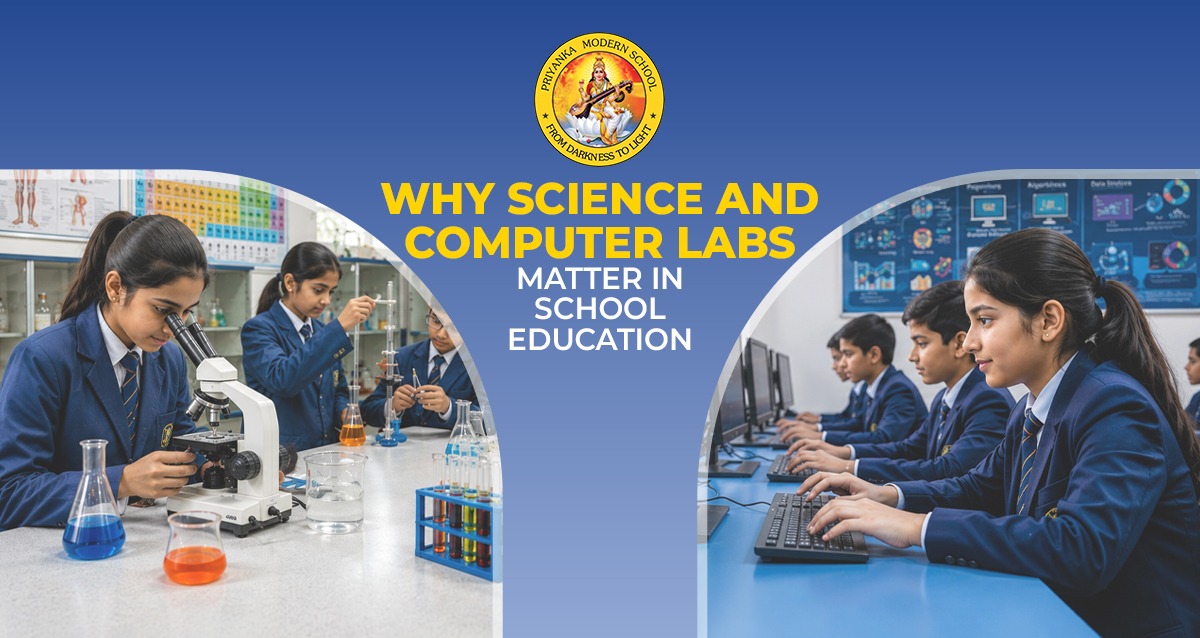
Why Science and Computer Labs Matter in School Education
Quick Answer: Science and computer labs in schools give students hands-on, practical exposure to
concepts that are difficult to fully grasp from textbooks alone. Science labs develop
observation, experimentation and analytical thinking. Computer labs build digital literacy,
problem-solving and technical skills. Together, they prepare students for a future where both
scientific reasoning and technology fluency are expected, not optional.
But that’s just the educational importance. If you ask most people about their school memories
then somewhere in there, you'll find a lab story. The smell of a chemistry experiment gone
slightly wrong. The first time you actually saw a cell under a microscope instead of just
reading about it. The excitement — or panic — of your first real computer class. There's a
reason those memories stick. Labs are where school stops being theoretical and starts making
sense.
The importance of science and computer labs in schools goes well beyond having nice facilities
to show parents during new admission days. These spaces are where students begin to actually
understand the world they live in and more importantly, start to figure out how to engage with
it.
Why Reading About Science Isn't Always Enough
There's a significant difference between a student who has read that plants absorb water through
their roots and a student who has actually grown one, measured it and observed what happens when
conditions change. Both have the information. Only one has really learned it.
This is the core value of science and computer labs in schools — they take abstract oncepts and
make them real. Physics stops being just formulas when students can physically measure velocity,
resistance or refraction. Chemistry becomes genuinely interesting the moment a reaction happens
right in front of you, not on a page. Biology makes a different kind of sense when you're
looking at an actual specimen or preparing a slide for a microscope.
The understanding that comes from doing something is deeper and more durable than the kind that
comes from just reading about it. That's not a new idea but it's one that lab-equipped schools
take seriously.
What Science Labs Actually Develop in Students
Good school science labs — whether for biology, chemistry or physics — develop a particular way
of thinking that's useful far beyond the subject itself.
When a student runs an experiment, they're not just following steps. They're forming a
hypothesis, observing results, comparing what they expected with what actually happened and
figuring out what that difference means. That process — predict, test, observe, interpret — is
how good thinkers approach problems in any field.
Labs also build patience and attention to detail. A chemistry experiment doesn't forgive
imprecise measurements. A physics observation doesn't work if you're not watching carefully.
These habits, built gradually through practical work, carry over into how students approach
everything from exams to real-life problem-solving.
And there's the confidence factor. A student who has handled actual lab equipment, conducted
real experiments and arrived at their own conclusions through observation carries a kind of
self-assurance into higher studies that a purely textbook-educated student often doesn't.
What Computer Labs Bring to the Table
The argument for computer labs has only got stronger over time. Whatever career path a student
takes, digital skills are no longer optional extras — they're baseline requirements. A computer
lab in school is often where that foundation gets built.
At the practical level, computer labs give students hands-on experience with the tools they'll
encounter in college and beyond — typing, word processing, spreadsheets, presentation software
and internet research. But beyond the basics, a good computer education starts developing
computational thinking: the ability to break a complex problem into smaller parts and work
through it logically. This is the kind of thinking that underpins programming, data analysis and
even fields that aren't traditionally technical.
There's also a significant equity argument here. Not every student has access to a computer at
home. A well-run school computer lab makes sure that a student's digital education doesn't
depend entirely on what their family can afford.
How Labs Shape the Path to Higher Education and Careers
For students heading toward science, engineering, medicine or technology — lab experience isn't
just useful, it's expected. Colleges and competitive entrance exams like JEE and NEET assume a
level of practical exposure that classroom teaching alone doesn't provide. Students who have
spent real time in properly equipped labs are simply better prepared for that
transition.
But the value isn't limited to STEM careers. The problem-solving discipline of science labs and
the digital fluency of computer labs benefit students in commerce, humanities, design, media and
virtually any field that requires thinking clearly, working with data or using technology —
which at this point is almost everything.
What Good Lab Facilities Actually Look Like
Not all labs are equal. A well-equipped science lab should have working instruments relevant to
the curriculum, proper safety measures in place, adequate space for students to actually work
and a teacher who knows how to run practical sessions meaningfully. A computer lab should have
functional machines, reliable internet access and a structured approach to what students are
doing — not just free browsing time.
The way a school invests in its labs tells you something about how seriously it takes practical
education. A school that prioritises lab infrastructure is making a clear statement about what
kind of learning it believes in.
This connects closely to the broader role of technology integration in schools — something the
post on how
smart classrooms are changing the way children learn goes into further and which
naturally complements what labs provide.
D
Conclusion
Science and computer labs in schools aren't extras or showpieces — they're central to how
students develop the thinking, skills and confidence they'll carry into higher education and
adult life. Labs make abstract concepts tangible, build habits of observation and reasoning and
give students the kind of practical exposure that textbooks simply can't replicate. The
importance of science and computer labs shows up most clearly not during the school years
themselves but in how prepared students feel when they get out the other side.
For families looking at modern
schools in Bijnor and the surrounding region, Priyanka Modern
School in Dhampur stands out as one of the few schools in the area that takes this
infrastructure genuinely seriously. The school maintains dedicated and separately equipped labs
for Biology, Chemistry and Physics — each designed to support the CBSE curriculum's practical
components with the right instruments, safety standards and supervised learning. The Computer
Lab adds a strong technology strand to this, ensuring students build digital skills alongside
their academic ones. As a CBSE-affiliated co-educational institution running from Nursery
through Class XII, Priyanka Modern School's investment in practical learning facilities is part
of a broader commitment to education that develops the whole student — academically,
analytically and practically.
So if you're looking for a school where lab-based learning is taken seriously and not just
listed as a checkbox, Priyanka Modern
School is well worth a visit and a conversation.